 BK Home Ops
 BK Home Ops
Your home should work for you.
Not the other way around.
Smart-home systems that feel impressive, intuitive, reliable, and easy to live with - without unnecessary lock-in.
Lights, shades, climate, locks, cameras, sensors, entertainment, and everyday routines can work together in ways that feel almost like magic.
Now offering 3 complimentary smart-home assessments for Palm Beach County homeowners.
Manual control: respected
Cloud dependency: minimized where practical
Ownership: documented
3 local spots
I'm opening 3 complimentary local smart-home assessment spots.
I'm working with a small number of Palm Beach County homes so I can listen closely, understand what is actually happening, and keep the work personal, practical, and useful.
If your smart-home setup feels confusing, unreliable, underused, or harder than it should be, tell me what is going on. If it seems like I can be useful, we'll set up one of the 3 local assessment spots and I'll take a practical look at what you already have.
Useful for frustrating systems, renovations, upgrades, or new smart-home plans that need a better path. Learn how it works.
What to expect
What happens in an assessment?
The assessment starts with your home, your routines, and what you wish worked better - not a list of products to buy.
We talk
We start with what works, what's frustrating, and what you wish your home could do.
I understand what you have
I get a clear picture of the relevant devices, platforms, apps, automations, and systems already in the home. Depending on what we're solving, that may include an on-site visit.
I look for opportunities
I look for where things could work better together and where automation could genuinely make life easier.
We make a plan
I walk you through what I found, what I'd change, what I'd leave alone, and what is worth exploring next.
These first assessments are complimentary because I'm working closely with a small number of Palm Beach County homeowners while I develop BK Home Ops around real homes and real needs.
Request an assessmentA quick example
A better smart home should understand context.
A motion light should not turn itself back on right after someone manually turned it off. Bedtime should not require checking five rooms. A garage arrival should not depend on one flaky signal.
The point is not just adding more smart devices. The point is designing rules that make sense to the people living in the home.
Your house should be more fun, more useful, and less annoying to live with.
The problem
A smart home is not really working if it only works for the person who set it up.
Smart homes often start simple and become a mess of apps, hubs, rules, cloud services, and devices that do not quite work together.
Maybe the lights are smart, but nobody remembers which app controls them. Maybe the shades, cameras, garage, thermostat, voice assistants, and sensors all work individually, but the home still feels like it needs a part-time operator.
What better looks like
Calmer, clearer, more natural to live in.
A better smart home should still be capable of doing things that make people stop and say, “Wait, your house does that?” The difference is that it earns trust instead of making everyone tiptoe around it.
The goal is to automate the right things for the people who actually live there.
One home, not separate systems
Lighting, shades, climate, locks, cameras, sensors, music, and outdoor spaces can work together instead of behaving like separate islands.
Different behavior for different moments
Arriving, leaving, sleeping, entertaining, movie night, and away mode should change the feel of the house without a pile of manual steps.
Automation with a light touch
The home should anticipate what is useful without constantly demanding attention, and manual control should always win.
Ownership that survives changes
Everyday preferences should be adjustable, while local control, documentation, backups, and clear ownership keep the system from becoming a black box.
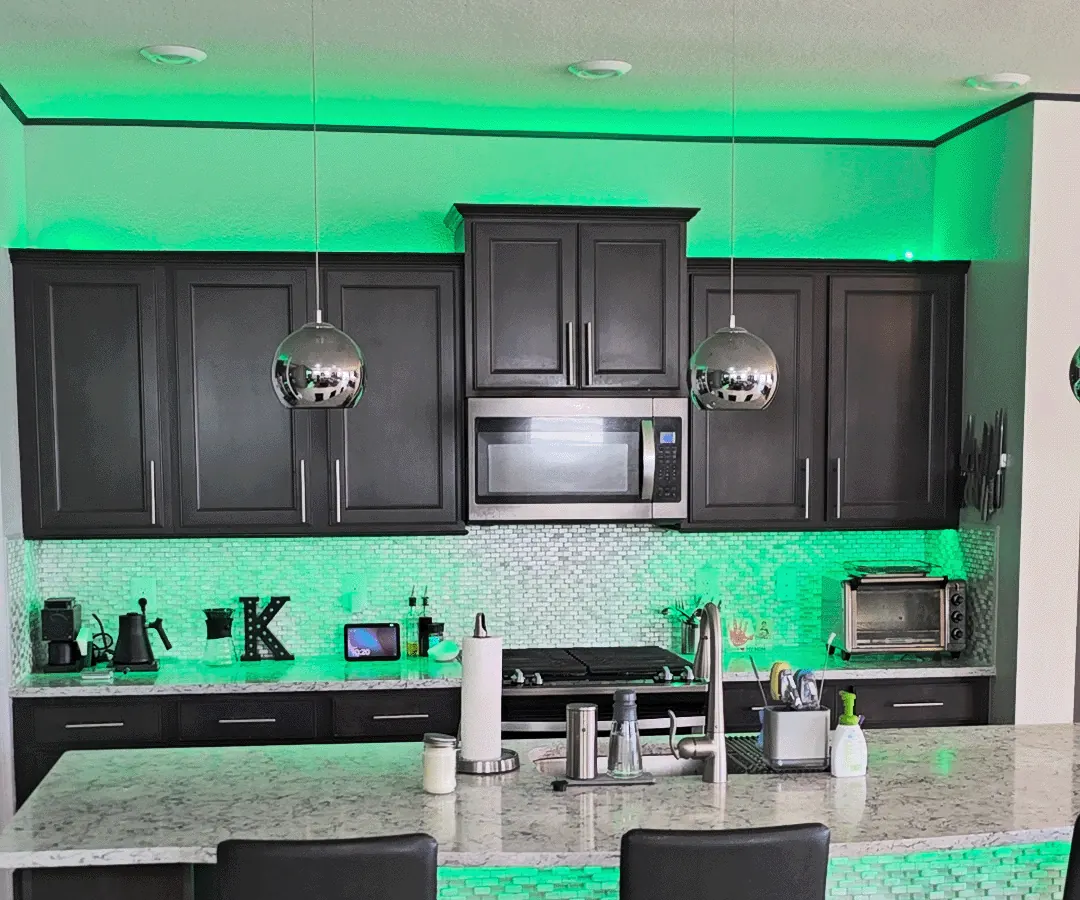
Real examples from my home
A good smart home solves little annoyances before the household has to think about them.
These are not meant to show off complexity. They show how the house can quietly support daily life when the design respects context, safety, and the people in the room.
The more sophisticated the home becomes, the more important it is to design it well from the start.
Evening routines
Bedtime
Getting into bed can shift the house into nighttime mode: common-area lights and TVs turn off, doors lock, and the bedroom lighting winds down for sleep. The kitchen even switches to dim, motion-activated lighting, enough to see without fully waking you up.
Household signals
Laundry
When the washer or dryer finishes, subtle accent lighting can let the house communicate that something needs attention, and stop once someone actually handles it.
Smarter context
Arrival
The garage can recognize a real arrival using multiple signals instead of depending on one unreliable trigger, making convenience possible without giving up sensible guardrails.
People first
Manual Overrides
If someone turns off a motion light, the house should respect that instead of immediately turning it back on.
A smart home should not win an argument against the person standing in the room.
Philosophy
Designed for you. Owned by you. Supported by me.
BK Home Ops is built around a simple belief: premium home automation should make the homeowner more in control, not less.
A better system should not trap every small preference behind a black box. Premium does not have to mean mysterious.
- No unnecessary proprietary lock-in.
- The best tool for the job, not one vendor stack by default.
- Good existing hardware preserved where it still makes sense.
- Systems that remain understandable, maintainable, and documented.
- Customer-owned accounts, platforms, and home infrastructure wherever possible.
- Support that creates confidence instead of dependency.
About Bryan
Built and lived with, not just designed on paper.
I have been building smart-home systems since January 2015, starting with the original Wink era and evolving through Hubitat, Home Assistant, voice assistants, Z-Wave, lighting, shades, locks, sensors, cameras, dashboards, local services, and more.
Over the years, I learned that the hard part is not connecting more devices. The hard part is designing a system that stays reliable, understandable, and actually improves daily life.
Read the full storyWhat could work better?
Request an assessment.
Tell me what works, what drives you crazy, or what you wish your house handled on its own. These first Palm Beach County assessments are for homeowners whose smart-home setup is close, but still feels harder than it should.
Have something else in mind? Start a conversation. Or take the Automation Personality Quiz.